
Team Members

Jason Baterna, Reagan Dateno, Ajani Frank, Madeleine Hulbert, Leyton Kounlavong, Andrew McGill, Michael Milligan, Anna Terlep, Robert Wickman, Harry Wessels
Abstract
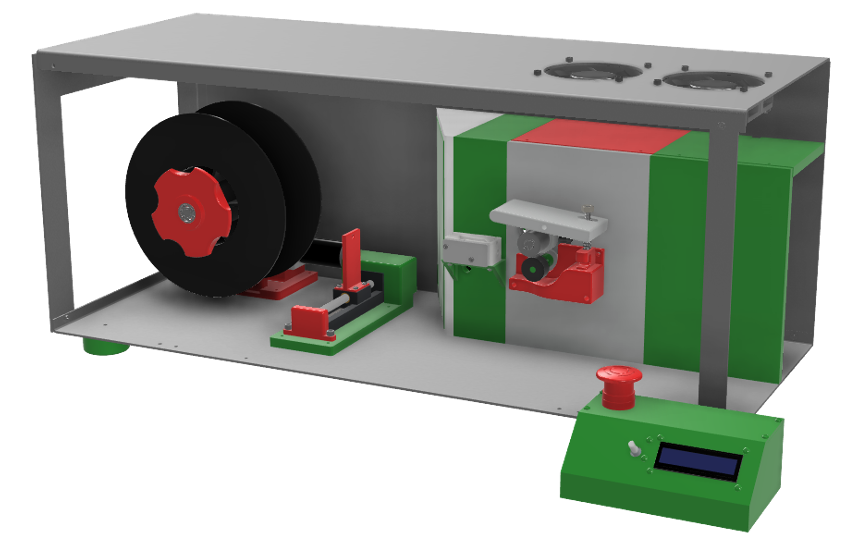

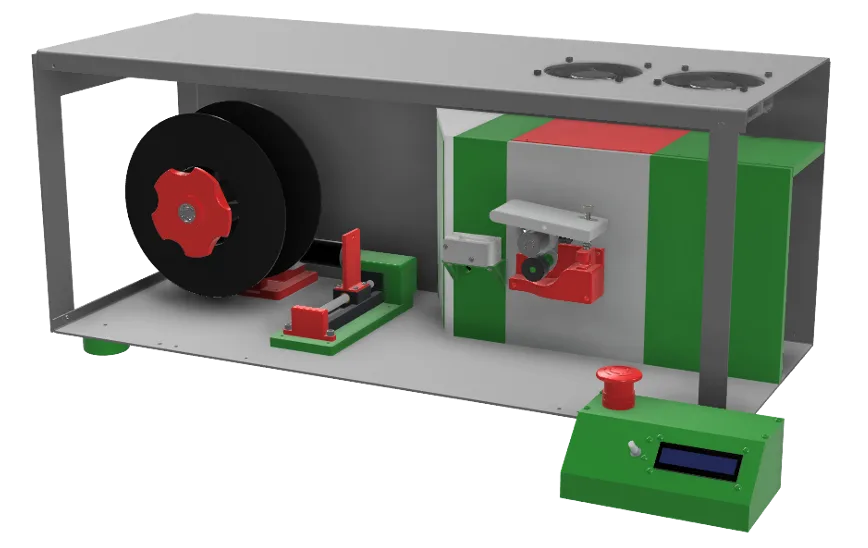
In pursuit of reducing filament waste and material costs for users, our company makes 3D printing more economically accessible by curating the world's leading customizable, efficient, and customer-centric filament recycling ecosystem, built around our modular recyclers and a subscription service for lifetime support. Our product, the Basilisk, provides an all-in-one filament cooling, diameter measurement, and spooling system. After going through the fans in our cooling system, a tensioning system, composed of a DC motor-driven and free-spinning roller, grips the filament using friction and a clamping force from a compression spring. A closed-loop feedback system is used to change the speed of the rollers to modify tension to maintain the desired filament size. An Infidel using a hall effect sensor measures the filament diameter, with an oscillating needle on a linear actuator guide rail preventing tangling when the filament is wound onto the spool. The spooling includes a gear system rotated by a DC motor operating at the same speed as the tensioning rollers. Additionally, the user interface is detached and can be placed in the surrounding area as the customer desires, optimizing for space and accessibility. Our product is also designed around add-ons, increasing productivity and aesthetics. Users have the option to purchase a plexiglass add-on for which the holes are already drilled, providing a cleaner look and encouraging safety. While the original system is designed around PLA filament, a PETG controller will also be available for purchase, with the tension and cooling systems calculated for those material properties.
Pitch Video
3D Interactive Product Model
The following is an interactive 3D model of the product design. You can view and rotate the product assembly in different orientations and views, including an exploded view to see the various parts that make up the assembly.